
ICE Locator
(888) 351-4024
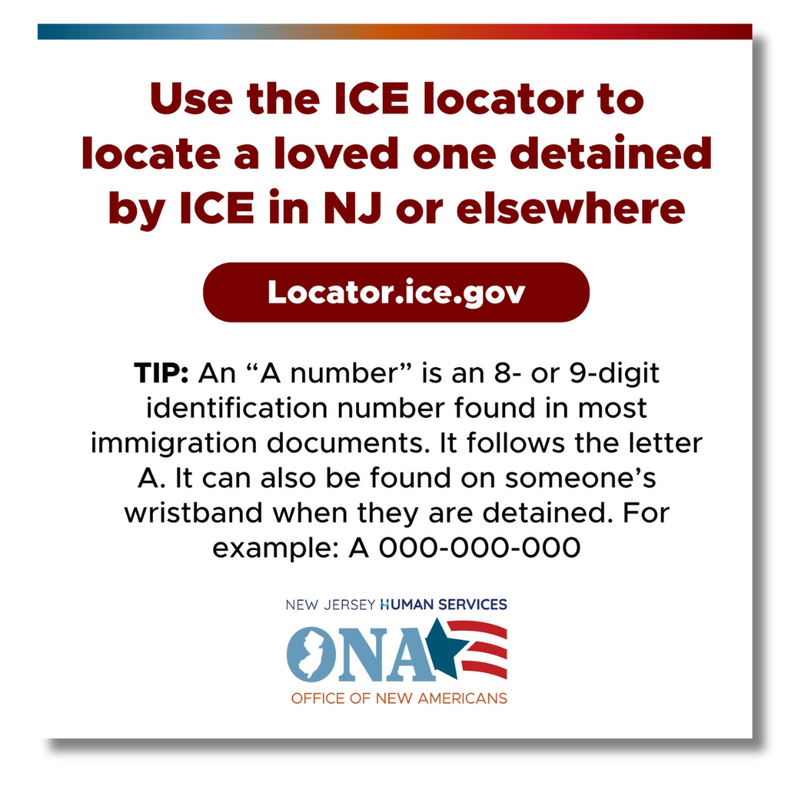
Use this page to locate a detainee who is currently in ICE custody or who has been in U.S. Customs and Border Protection’s custody for more than 48 hours.
Online Detainee Locator System cannot search for records of persons under the age of 18.
Search by A-Number
If you know the detainee's A-Number, ICE recommends you use the A-Number search. The A-Number must be exactly nine digits long. If the A-Number has fewer than nine digits, please add zeros at the beginning. You are also required to select the detainee's correct Country of Birth. (* Required Field)
Search by Biographical Information
When searching by name, a detainee's first and last names are required and must be an exact match (e.g., John Doe will not find Jon Doe or John Doe-Smith). When inputting a hyphenated last name into the Online Detainee Locator System, please include hyphen in order for the locator to find the individual (e.g., Doe-Smith). You are also required to select the detainee's Country of Birth. (* Required Field)
What information does ICE collect about me when I use the ODLS website?
ODLS collects limited information about you when you use the system. You do not need to set up an account, provide any information about yourself, or get special permission to use the system. When you visit the website, the system does collect limited technical information including your Internet domain, Internet Protocol (IP) address, and the Internet address of the website from which you linked directly to the ODLS website. This information is collected to allow ICE to troubleshoot issues with the system and to monitor and protect the system from cyber-attacks. It is not used to identify people who use ODLS, to track what they search in the system, or to assist with immigration enforcement activities.
Additionally, the ODLS website uses session cookies. Session cookies are small bits of text that do not collect any information about you but are used to track you and help you while you navigate throughout the ODLS website. The cookies only last for the duration of an active browser session, and once you close your browser or your browser has been inactive on the website for 20 minutes, the cookie is deleted.
For more information on the limited technical information that is collected and on the session cookies that are used, please see the ODLS privacy policy.
What is an A-Number?
The A-Number (short for Alien Registration Number) is the immigration benefits or enforcement proceedings. The nine-digit A-Number may be preceded by zeros. A-Numbers are assigned one per person. The A-Number can be found in the top right corner of the Notice to Appear (NTA), Form I-862.
Does ODLS have information about all persons in ICE or CBP custody?
No. ODLS does not contain information about all persons in ICE or CBP custody. For example, juveniles (detainees under the age of 18), and those who have been in CBP custody for less than 48 hours are not in the system.
Can I use ODLS to find out if an immigration detainer has issued for a person in local custody?
No. If you have questions about immigration detainers for specific individuals, contact the ICE Office of Enforcement and Removal Operations (ERO).
How current is the information in ODLS?
ODLS information may be anywhere from 20 minutes to eight hours old. ICE policy requires that its systems be updated within eight hours of the release, removal, or transfer of detainees. In most cases, detainee information is updated more quickly, but people planning to visit a detainee should call ahead to the detention facility to confirm the detainee is still at that location.
Does ODLS show when a detainee is being transferred between facilities?
No. For security reasons, ODLS does not provide information about transfers that are planned or in progress. Once a person is transferred and booked into another ICE detention facility, ODLS will be updated with that information.
How do I find out if a person was removed from the United States?
ODLS does not reveal whether a person was removed. The system will only reveal if a person is currently in ICE custody. Family members and legal representatives may be able to obtain additional information about a persons removal status by contacting the ICE Enforcement and Removal Operations (ERO) responsible for that persons immigration case. (The responsible ERO offices contact information is displayed in the persons ODLS record. Alternatively, you may contact the ERO office in the area where you believe the persons immigration case was initiated.)
I can't find the person in ODLS. What should I do?
First, re-check the search terms you entered to ensure they are correct, and try your query again. Please remember the system does not provide information for some persons such as juveniles (detainees under the age of 18) or those in CBP custody less than 48 hours.
If you conducted a name-based search, remember that only exact matches to the name you entered will be returned. You may want to try searching using any name or spelling variants used by the person.
If you conducted an A-Number search, you may want to try conducting a name-based search instead.
If you do not have a correct country of birth, you will not be able to find the person in ODLS.
If you are unable to find the detainee using ODLS, you may contact the ICE Office of Enforcement and Removal Operations (ERO) in the area where you believe the person's immigration case was initiated or the Detainee Reporting and Information Line (DRIL) at 1-888-351-4024.
If you are unable to find information on the individual you are looking for and you believe they are missing, please contact your respective consulate or embassy for further assistance, for more information visit www.state.gov . For more information, please see the Missing Migrant Program.
What is the Missing Migrant Program?
The Missing Migrant Program is a humanitarian effort, led by the U.S. Border Patrol (USBP), that focuses on border safety, locating migrants reported missing, rescuing migrants in distress, preventing migrant deaths, and identifying and reunifying decedents with their families in the border region. CBP strategically placed technology and 9-1-1 rescue placards in remote areas for migrants in distress to prevent fatalities in the field. The Missing Migrant Program also helps family members who may be looking for their loved ones who may have perished or been separated at the border through internal and external entities. CBP coordinates and shares information of missing migrants with external entities such as state and local officials, and foreign consulates to help reunite them with family or resolve missing person cases.
What is the best search method when using ODLS?
Searching for a detainee by A-Number will return a better match.
Can I visit a detainee once I have located them in the system?
If the status of the detainee shows "In Custody", select the "Current Detention Facility" link which will provide the contact information for the detention facility where the detainee is being held. You should contact the detention facility to confirm the detainee is still at that location prior to visiting.
CBP makes every effort to promptly transfer, transport, process, release, or repatriate migrants as appropriate and operationally feasible. Due to CBP not having long-term detention facilities, visitation is not available at CBP facilities.
What type of information will I need to visit a detainee in a detention facility?
A government-issued photo identification or other identification when photo identification is unavailable for religious reasons is required to visit a detention facility. However, you should contact the detention facility you plan to visit in order to find out what their policies and regulations are regarding visitation.
| Age Groups |
|
| Community Services |
Basic Needs / AssistanceCommunityLegal / Advocacy |
| Payment Types |
|
Last Updated: 06/25/25